
The same financial statements sit behind a valuation, a loan, a deal package, and an acquisition. What changes is the decision, and the work it takes to get there.
A property's operating history, the record of its actual income and expenses over prior periods, is one of the most widely read documents in commercial real estate (CRE). A valuation firm reads it. So does the broker packaging the deal, the bank underwriting the loan, and the REIT weighing an acquisition. Same statements, four sets of eyes, four different questions.
What separates them isn't whether they look at operating history. Everyone does. It's what they're trying to decide, and how much manual work stands between the raw statements and that decision.
That gap is where most of the friction lives. Historical financials arrive in inconsistent formats, often as partial years, rarely lined up with the way a model is built. Before anyone can use them, someone has to re-key them and reshape them into something comparable. The analysis that actually informs the decision comes last, after the grunt work is done.
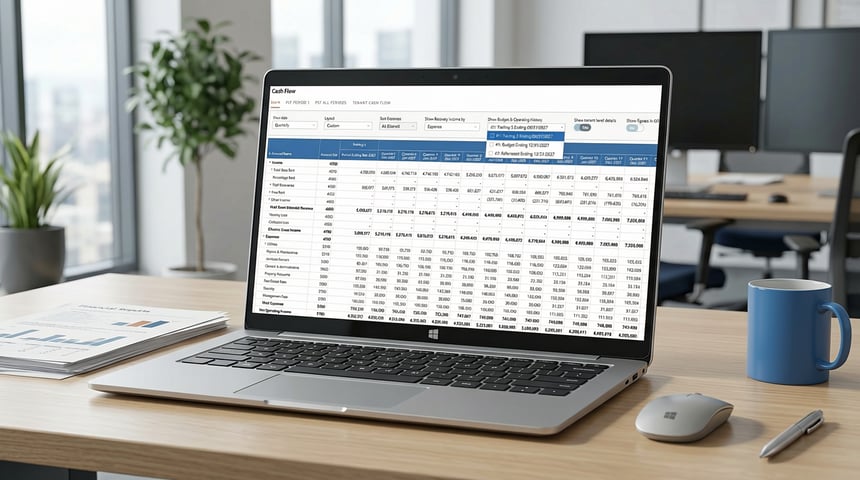
Rockport VAL closes that gap by bringing historical operating statements, budgets, and reforecasts directly into the CRE and multifamily model. Historical financials are entered, standardized, and set alongside projections in the same place, so the forecast is anchored to how the asset has actually performed rather than a rebuilt approximation of it. The work below is what that looks like for each of the four audiences.
How do valuation firms use a property's operating history?
A valuation firm is producing a credible, defensible value, and operating history is the evidence base for it. Analysts normalize income and expenses into a consistent basis and separate stabilized performance from one-off events, then support the conclusion with numbers a reviewer can trace back to the source.
The slow part is rebuilding those historicals from PDFs and inconsistent borrower formats before the real analysis can start. In VAL, that preparation happens inside the model rather than in a separate spreadsheet, so the analyst spends more time on the judgment a valuation turns on and less time reconstructing the numbers. For valuation firms, VAL means less rebuilding and faster, more defensible valuations.
How do mortgage brokers use operating history to package deals?
A broker is packaging a deal to put in front of lenders, and the clearer the picture of past performance, the more confidence a lender has and the faster the deal moves. The problem is that brokers work from whatever borrowers hand them, which is rarely clean and often arrives late.
VAL pulls that raw material into a consistent, lender-ready format, which means fewer surprises deep in the process and a package that holds up when a lender starts asking questions. For brokers, that adds up to stronger presentations, more closings, and less manual prep behind each one.
How do banks and lenders analyze operating statements for underwriting?
A lender is underwriting risk. Historical operating statements are how they validate what a borrower reports and judge whether past performance actually supports the loan. Much of that starts with spreading: taking inconsistent statements, including partial years, and converting them into a full, comparable annual view.
Done by hand across a portfolio, that work is slow and uneven, which is a problem when consistency is the entire point of credit review. VAL standardizes historicals and feeds them directly into the underwriting model, which makes the process faster and the decision easier to defend. For banks and lenders, that means more consistent underwriting and better-supported credit decisions.
How do REITs and institutional owners turn operating history into portfolio intelligence?
An institutional owner is deciding what to acquire and how the existing portfolio is performing. That means benchmarking assets against each other and tracking same-store trends to find where operations can improve.
The obstacle is data arriving from many sources in many shapes. VAL gets asset-level operating history into one consistent view, which is what turns a pile of statements into portfolio intelligence and lets acquisition and asset-management calls rest on comparable numbers rather than rough estimates. For REITs and institutional owners, that means sharper decisions across the whole portfolio.
The common thread
Everyone here reads the same operating history, but each is reaching for something different: the valuation firm wants a defensible number, the lender wants comfort on risk, the broker wants a clean package, the owner wants a sharper portfolio call. What slows all four down is identical, though, and it is the manual work between receiving a property's financial history and being able to use it.
That is the work Rockport VAL removes. When historical statements, budgets, and reforecasts sit inside the model alongside projections, the decision starts from real performance instead of a reconstruction of it. The question stops being how long it takes to prepare the history and becomes what the history tells you. That holds whichever seat you're in.

Posted by Vincent Borrelli
